

The Magic Tree House book series, written by Mary Pope Osborne, is a household name. Magic Tree House books are the perfect first novel for many younger elementary students. These books continue to captivate older students’ imaginations as well. This book series has stood the test of time in being engaging, entertaining, and educational.
Why Magic Tree House Books Are Perfect for Cross-Curricular Learning
Readers embark on historical and scientific adventures as Jack and Annie, through their magical tree house. They are whisked through time to magical worlds, faraway places, historical events, and more. From learning about dinosaurs in the prehistoric age to investigating ancient Egyptian pyramids. From braving tornadoes to surviving the Amazon. Jack and Annie befriending leopards and dolphins to venturing into blizzards. This series beautifully merges history with science, making it a cross-curricular dream.

With 28 books in the original series, it has expanded to graphic novels, Fact Tracker nonfiction books, and the Merlin Missions series for more advanced readers. Osborne is still publishing books to this day, offering a little something for every child’s interests.
Recommended for ages 6-10, this series captivates children in all grades, from students just beginning to read to older elementary children who can independently devour the adventures.
7 Magic Tree House Classroom PBL Activities Students Will Love
With so many options, the Magic Tree House series is ideal for independent reading projects and book clubs. Students can choose a book based on their interests and either read it independently or break into groups with peers who have chosen the same book. Teachers can even choose a couple of books that go along with their standards and curriculum, and allow students to choose from them for a book club.
Magic Tree House incorporates science and social studies within literature in such a way that students don’t even realize they are learning multiple subjects in one exciting reading adventure. It is an ideal book series for a well-rounded education.
As a former teacher turned homeschool mom, I’ve learned of homeschooling families that even utilize the entire series for their literature during 2nd-4th grades. The series has everything you need, so no wonder Magic Tree House books have become a classroom classic.
Magic Tree House books are filled with adventure, daring missions, and unforgettable journeys. Students are naturally drawn into Jack and Annie’s world, making project-based learning the perfect way to extend that excitement beyond the pages. By immersing readers in hands-on projects, they can dive deeper into the fascinating history, science, geography, and cultures woven throughout each story.
We have created a list of 7 projects that could work with any Magic Tree House novel. Just as Annie says in the books, “I wish we could go there!” Let’s dive into the projects the books have to offer and “go there!”
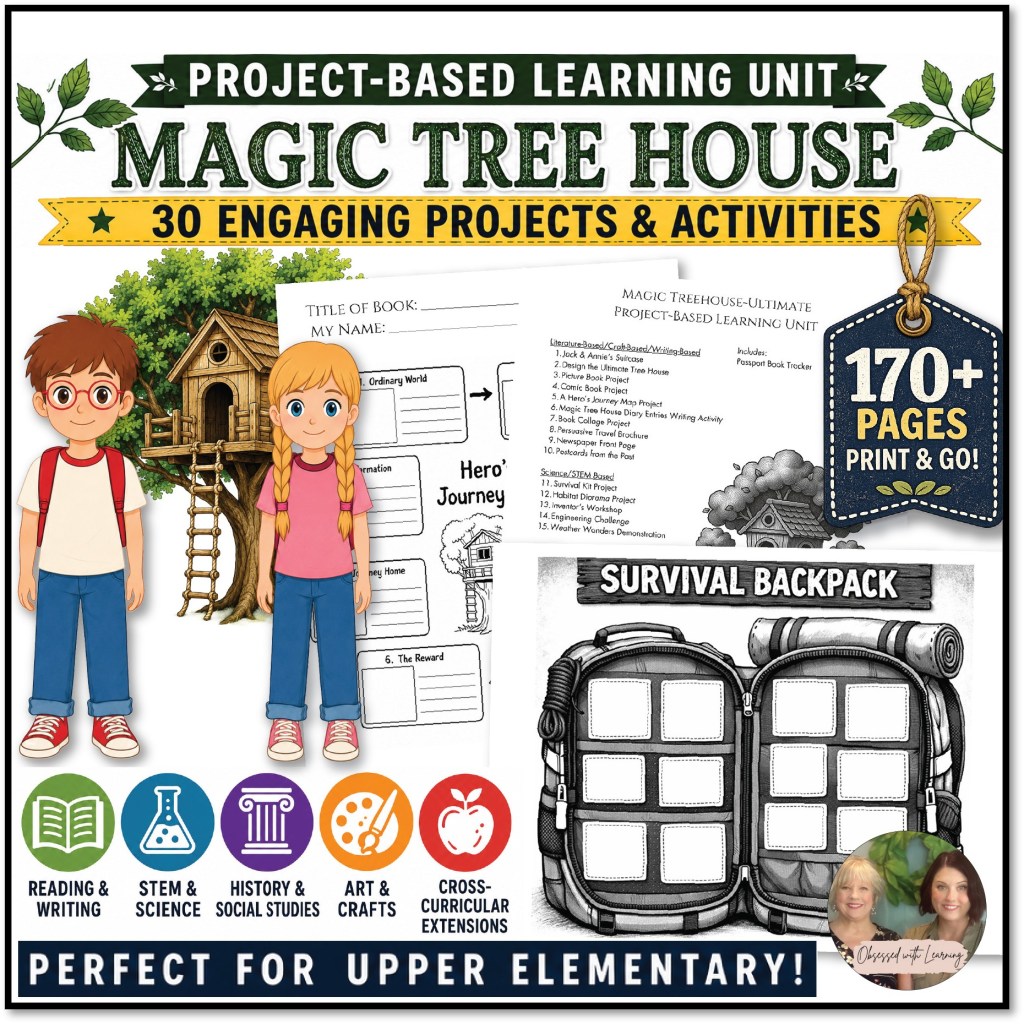
1. Hero’s Journey Story Map
When I first began reading the Magic Tree House series as a third-grade teacher, I realized it followed the arc of a hero’s journey, something I had learned in college literature. It’s a classic writing structure in which a hero leaves an ordinary life, goes on amazing adventures, learns something new, and goes back to their original life transformed. In Magic Tree House books, Jack and Annie follow this pattern as they travel to new places, solve problems, and grow from each exciting mission. Elementary students can analyze the storyline of a Magic Tree House book by tracing Jack and Annie’s adventure through the stages of the Hero’s Journey.

Students can create a map of their journey by identifying how the events in the story fit the stages of the Hero’s Journey. These are the various stages students would fill in:
1. Ordinary World
2. Call to Adventure
3. Entering a New World
4. Tests & Obstacles
5. The Crisis (Big Challenge)
6. The Reward
7. The Journey Home
8. Transformation
Readers draw a picture of a map or winding road and explain how Jack and Annie fit in each stage of the hero’s arc, and then illustrate each stage on the map. It’s a wonderful way to dive into literature by summarizing, analyzing, and synthesizing what they have read.
2. Pack Jack & Annie’s Adventure Suitcase
Students can brainstorm and explore the many needs Jack and Annie have while embarking on their travels in this fun suitcase writing craft project.

Readers decorate a suitcase for either Jack or Annie, or a shared suitcase for both characters. The outside of the suitcase should be decorated with images that detail the specific book. For example, Magic Treehouse Twister on a Tuesday might have an image of a tornado or a one-room schoolhouse. Next, readers decide which items Jack, Annie, or both characters would pack for their adventure. They choose objects that would help the characters complete the book’s mission.
Perhaps, for Magic Treehouse Twister on a Tuesday, the characters could really use a hard hat. Students draw the pictures on the outside and inside of the suitcase, or print images and paste them onto and into the suitcase. Finally, they write two paragraphs explaining the images on the outside and inside of the suitcase. This project incorporates inference skills, writing, and creativity.
3. STEM Engineering Challenge
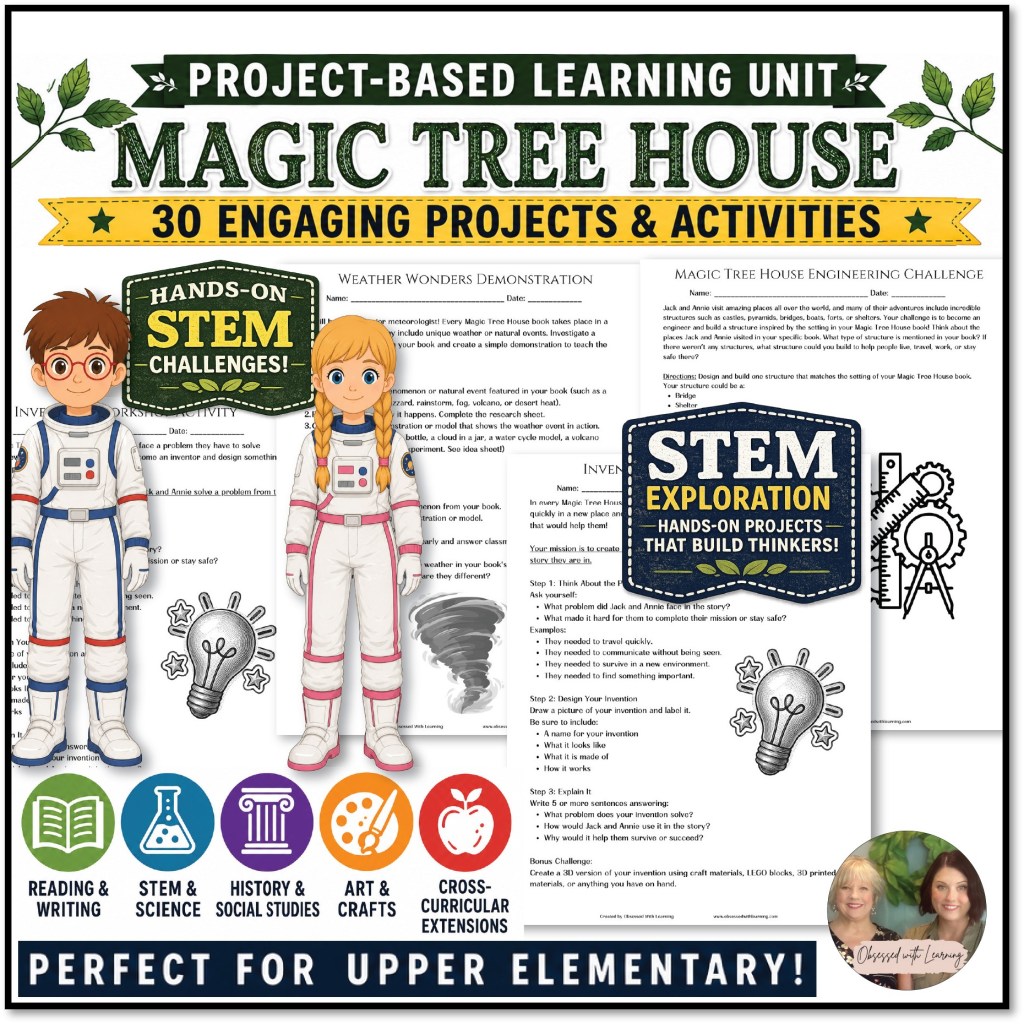
Jack and Annie visit amazing places all over the world, and many of their adventures include incredible structures such as castles, pyramids, bridges, boats, forts, or shelters. Students can become engineers, conduct research, and build a 3D structure inspired by the setting in their Magic Tree House book. Some ideas include building a drawbridge, the Eiffel Tower, or an Egyptian temple, among many other options. This project weaves STEM within literature in an exciting and hands-on way.

This full project, from planning sheets to a rubric, is included in our unit.
4. Weather Wonders Science Demonstration
Every Magic Tree House book takes place in a different setting, and many include unique weather or natural events. Students can investigate a weather phenomenon from their book and create a simple demonstration to teach the class how it works. Students, first, identify a weather phenomenon from their book like a tornado, hurricane, blizzard, rainstorm, fog, volcano, or desert heat. Then, they research how and why it happens and create a simple demonstration or model that shows the weather event in action. Some examples include a tornado in a bottle, a cloud in a jar, a water cycle model, a volcano eruption, or a rain cloud experiment.

Through this Weather Wonders demonstration project, students feel like they are experiencing the same weather Jack and Annie are living in, all while learning the science behind it!
5. Time Traveler Museum Project
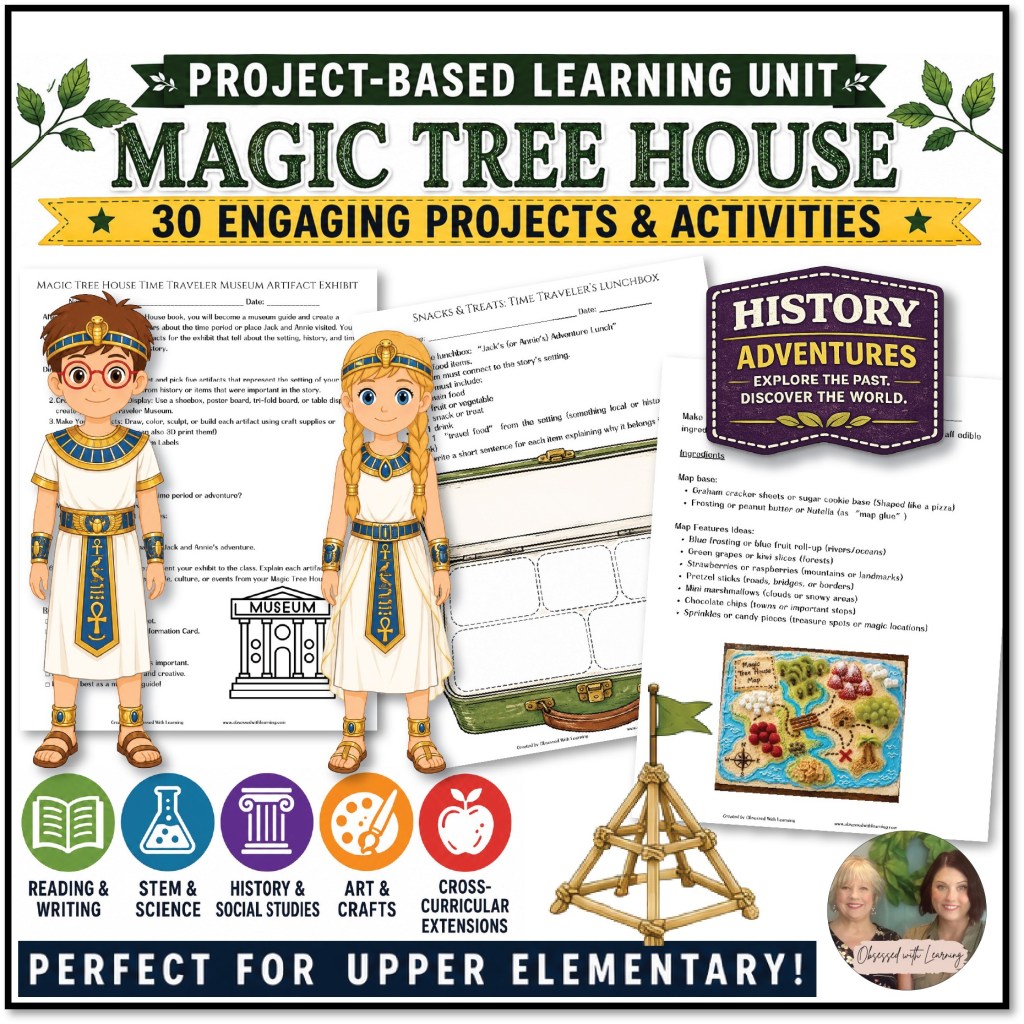
To concentrate on the history and culture present in the Magic Tree House series, students can become museum guides and create a museum exhibit that teaches others about the time period or place Jack and Annie visited.

Readers will “collect” or “create” artifacts for the exhibit that tell about the setting, history, and time period of the Magic Tree House story. Then, they create a Museum Display to showcase their artifacts. Students can draw, color, sculpt, or build each artifact using craft supplies or recycled materials. This project is fully hands-on and incorporates literature, art, and history, all in one!
6. Then & Now History Poster
In this project, students will compare the past (the time period in a Magic Tree House book) to the present day. Students can create a simple poster that shows how things have changed over time. Using the template in our unit, students create 5–8 drawings or writing pieces for the “Then” and “Now” sections of their poster. Students compare life in the past to life today by exploring different aspects of daily life. They can focus on clothing, homes, transportation, tools, technology, food, and everyday activities.

7. Reading Passport Book Tracker
For students reading multiple Magic Tree House books, a reading passport is the perfect way to track their adventures. In their Magic Tree House passport, students can draw “stamps” for the countries they visit in each book. Students can place a star on a world map for each destination. In addition, they can record fun facts about the location’s food, landmarks, and culture. Just as Jack and Annie travel to new and exciting places, readers can track their own adventures in their passport.

Magic Tree House Project-Based Learning Unit:
Bring every Magic Tree House adventure to life with our engaging Project-Based Learning unit. Packed with 30 hands-on activities that incorporate literature, writing, STEM, history, art, and cooking, this unit goes far beyond reading. Students build, create, write, design, investigate, and even cook their way through each story.

From engineering challenges and habitat dioramas to comic books, travel brochures, historical museums, edible maps, and treehouses, every project brings learning to life. Students make meaningful connections to literature, history, science, STEM, art, and writing. It’s the perfect way to transform your Magic Tree House novel study into an unforgettable learning adventure.
Make Every Magic Tree House Book an Adventure with Project-Based Learning
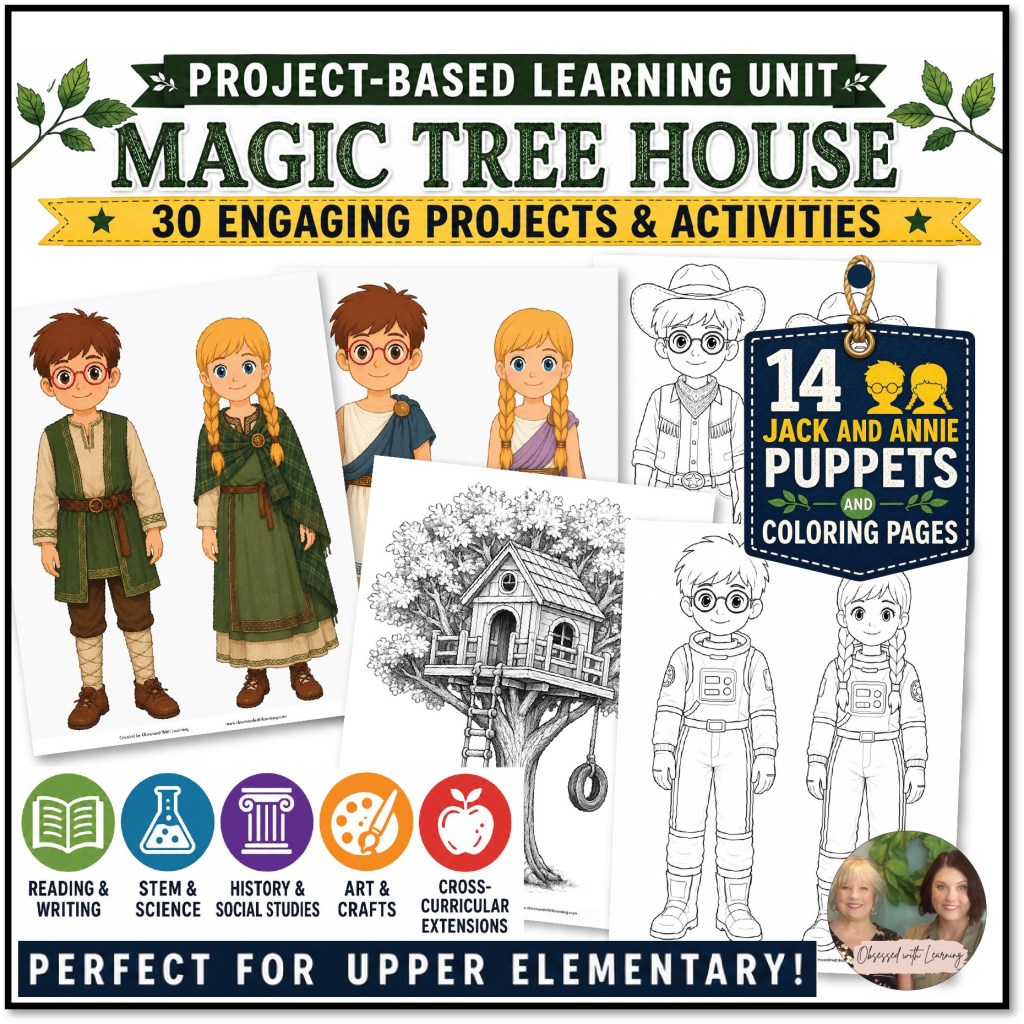
FREEBIE BONUS!
Conclusion: Bring Magic Tree House Books to Life
The Magic Tree House series has inspired generations of young readers to explore history, science, and the world around them. By pairing these beloved books with meaningful, hands-on projects, students become part of Jack and Annie’s travels. Whether you’re teaching in a classroom, homeschooling, or leading a book club, these activities will help transform every novel into an unforgettable, cross-curricular learning experience.
After all, just like Mary Pope Osborne says, “Reading is a passport to countless adventures.”
